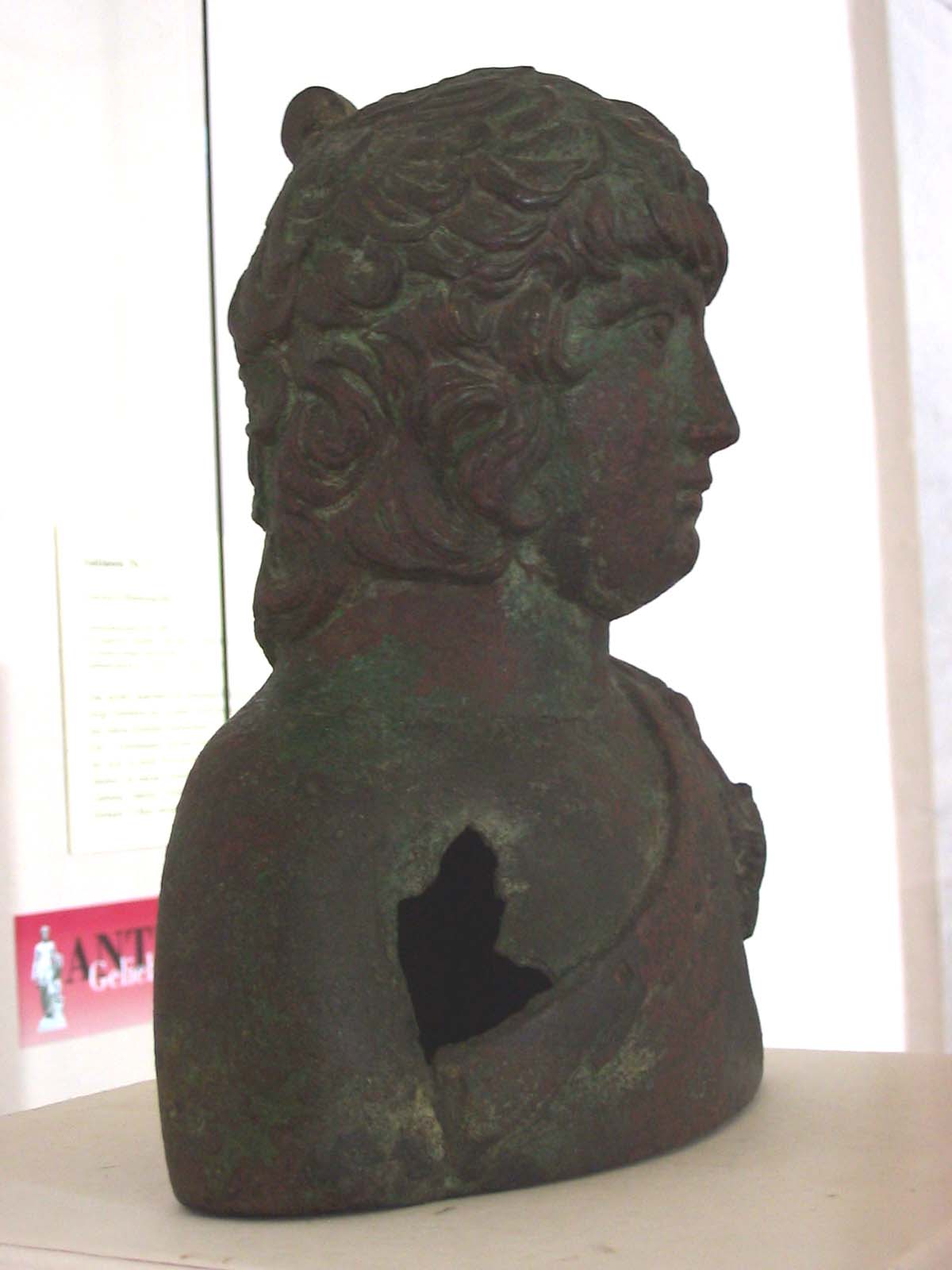
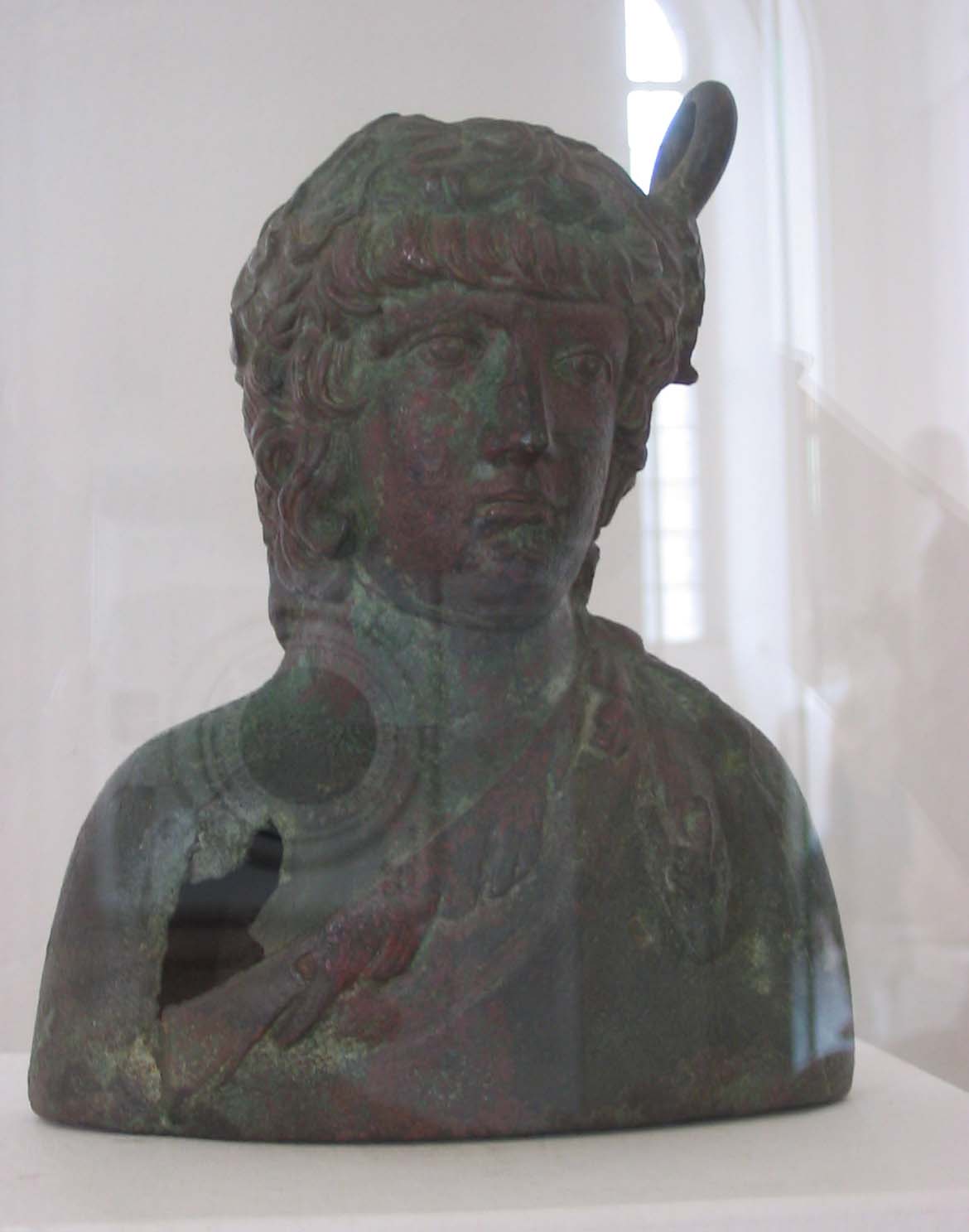
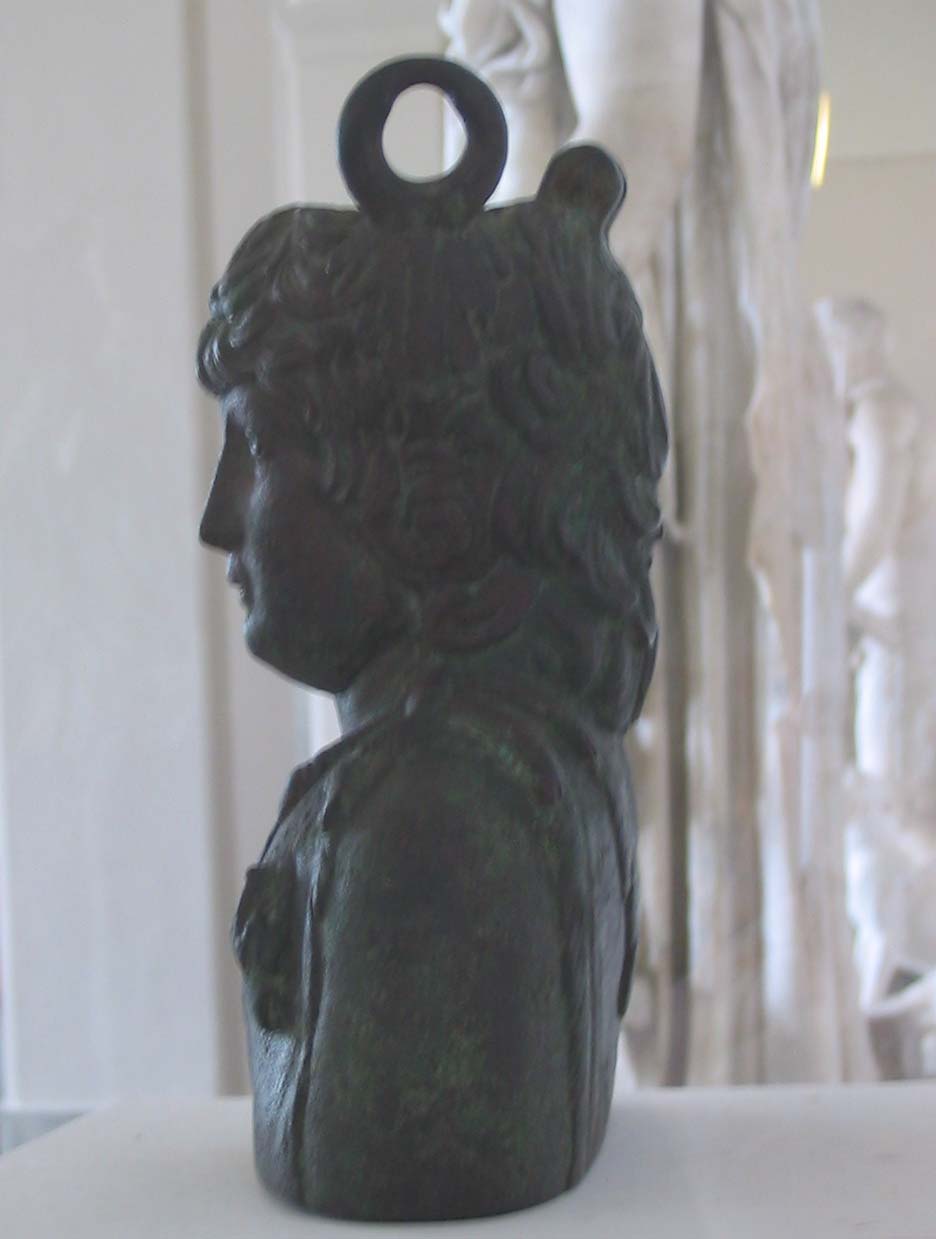
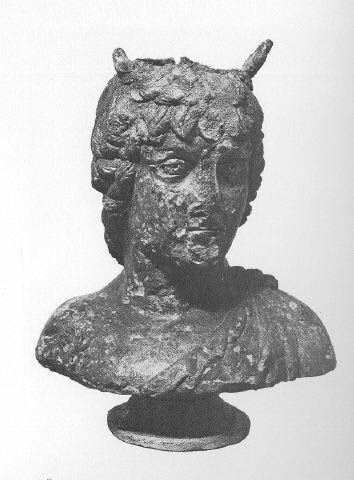
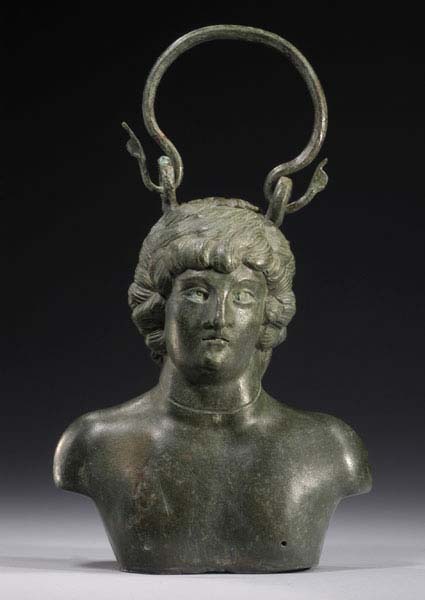
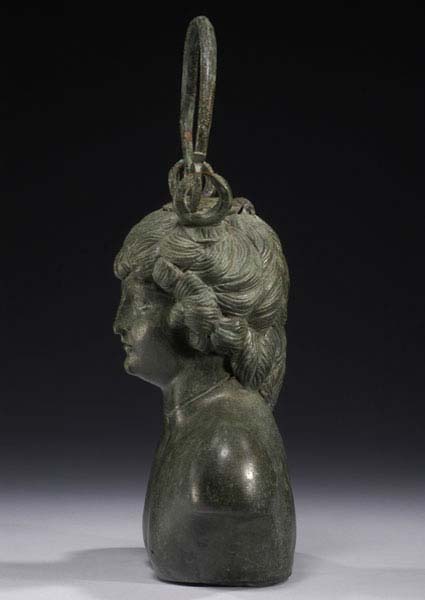
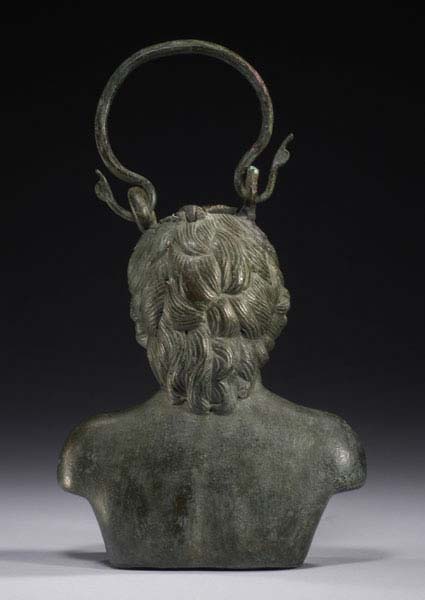
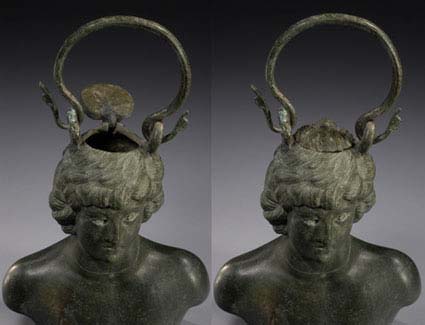
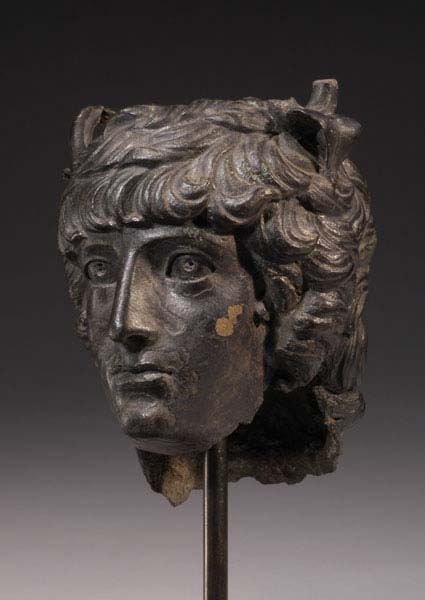
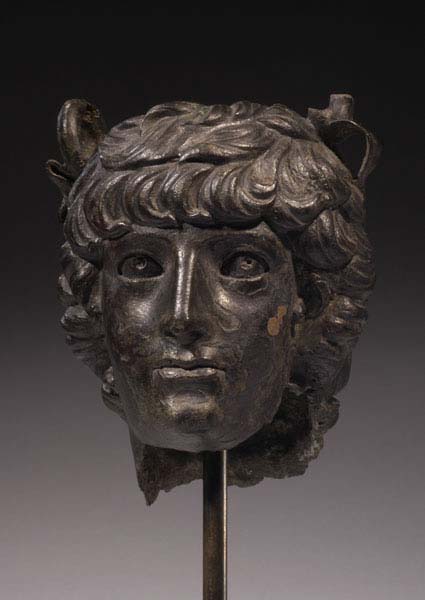
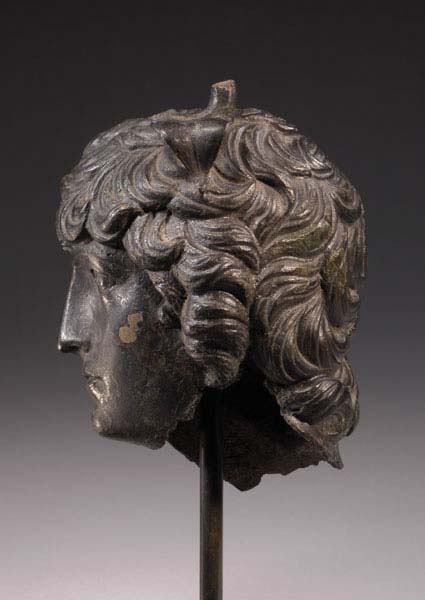
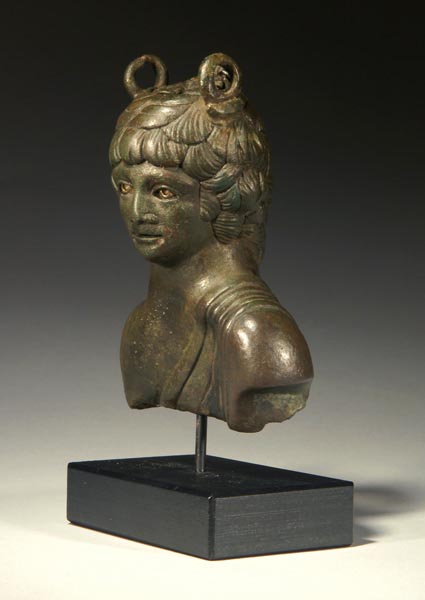
Royal-Athena Galleries, Art of the Ancient World, vol. XIX (2008), p. 34, n°67.
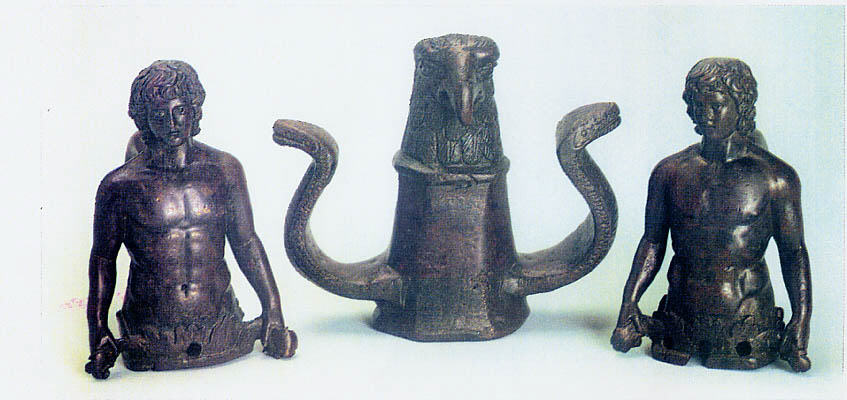
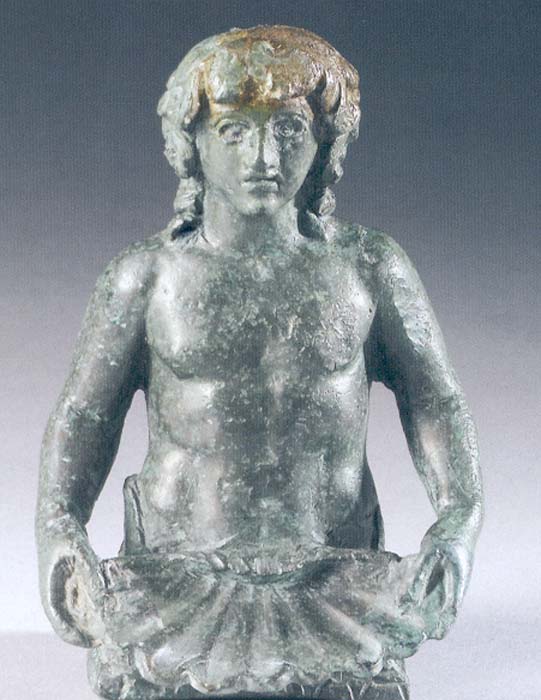
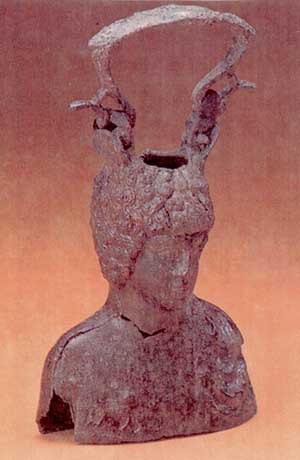
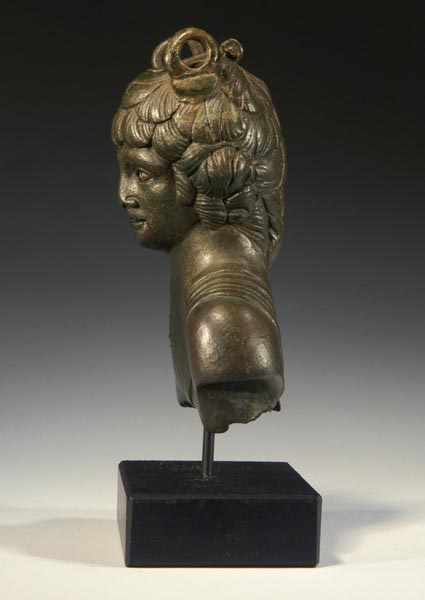
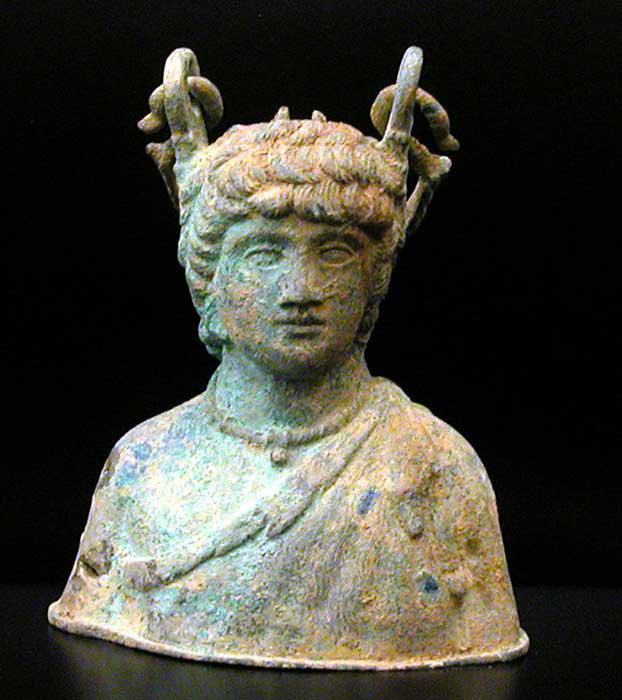
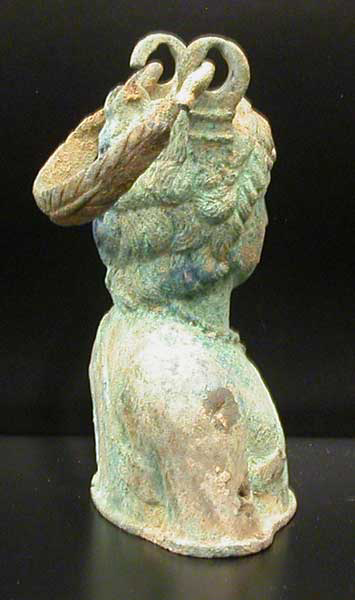
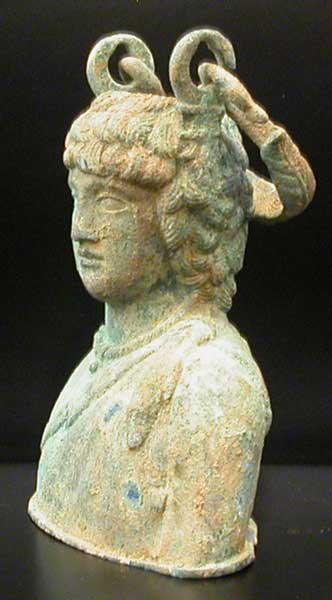
Pair of bronze busts, 12,5 cm high. Antinous, holding a scallop-shell tray and
depicted with particularly abundant hair, probably adorned a lectica, a portable
bed, popular mode of transportation for the well-to-do. Very rare as a pair. See
also Hermitage, V.866-867.
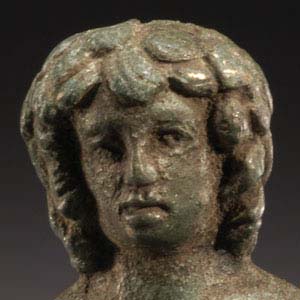
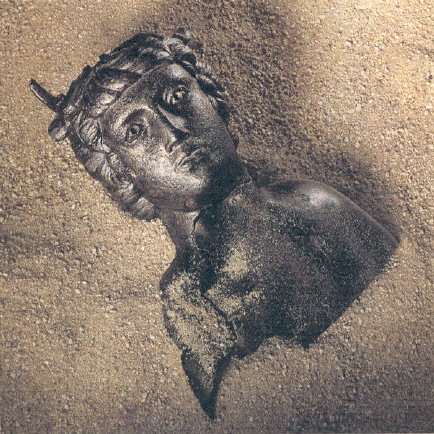
Paris, Musée Carnavalet,
Inv. N° AM 749, exhibited. Bronze head of Antinous. Probably found in 1878
during excavations, Rue Pierre-Nicole in Paris. «Le visage est grave
et teinté de mélancolie» (Jacqueline Bonnet, 1989)
St. Petersburg, Eremitage,
Inv. N° V866 and 867. Two bronze weights.
Museo Archeologico Sofia.
Bronze censer. «La derivazione greca del modelo appare evidente»
(Raffaele Mambella, 2000)
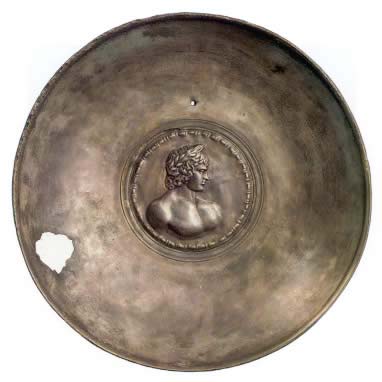
Tbilissi, Georgia, Historical
Museum. Silver bowl. «A fine sample of Roman silverwork» (Alexander
Javakhishvili, 2000)
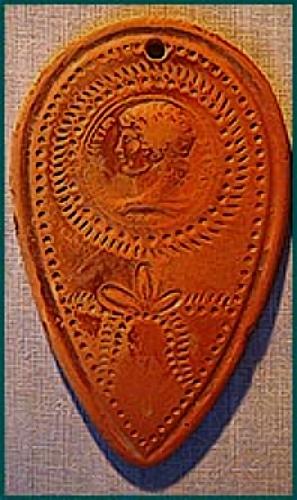
Museo Archeologico Aquileia, First Floor-Room VI. After 130 A.D. The cult of Antinous
is attested by two brick-tiles "plachette" with his portrait, probably ex-vota.
The Greek legend says: "His homeland [worships] God Antinoos", clearly meaning
Bytinion, now Bolu in Turkey, were he was born.
Private collection. Bronze,
10 cm high. Provenance unknown. Comparable to the two bronze weights of the Eremitage,
here above.
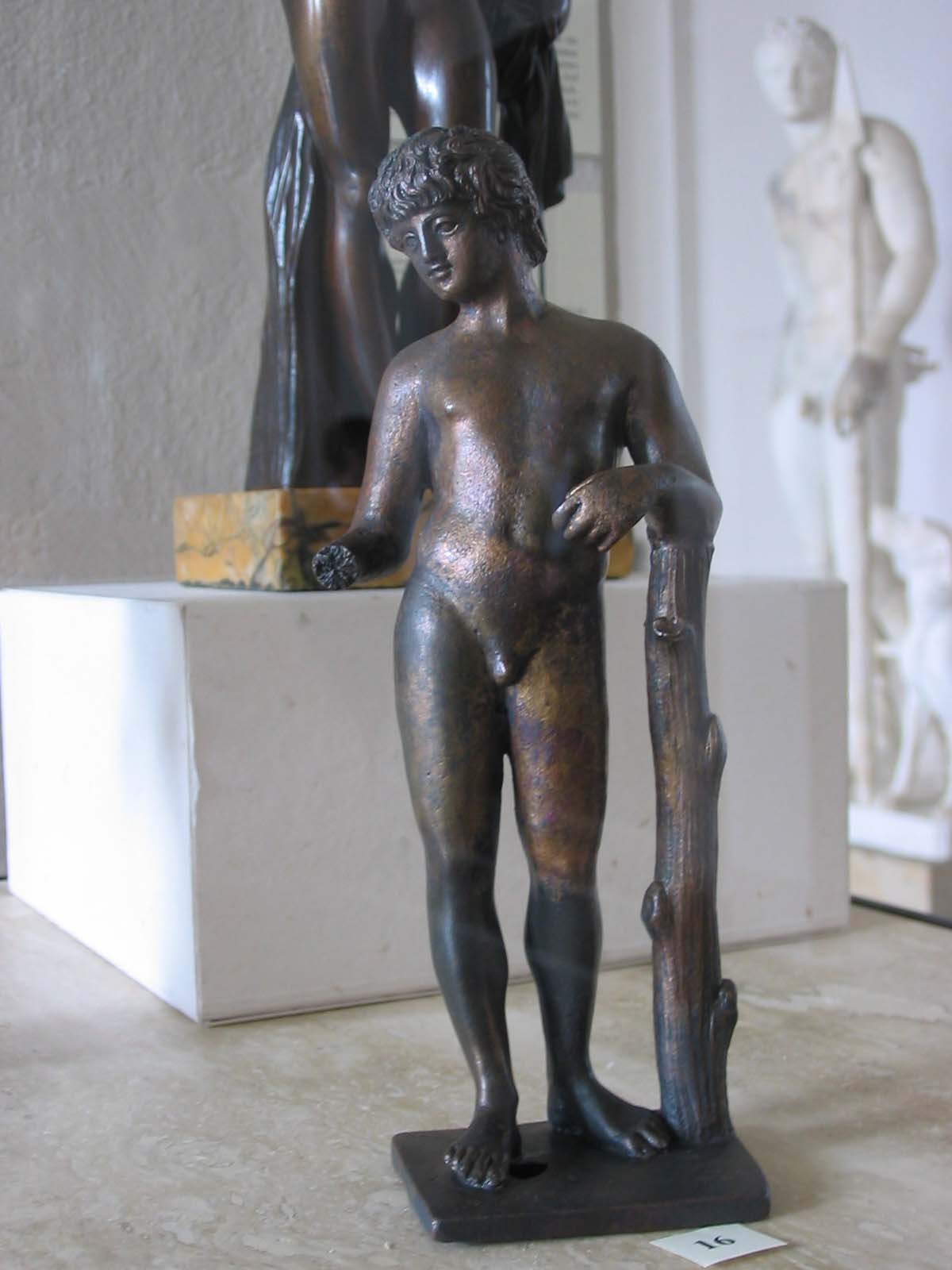
Bronze statuette dated end of 17th century. Its head and its pose are loosely
inspired by the Farnese Antinous, at that time kept in the Palazzo Farnese at
Rome. Height: 19.6 cm. Berlin, Antikensammlung, Inv. N° Y.1459. Recently (2005)
exhibited for the first time in the frame of the exhibition Antinoos, Geliebter
und Gott, held at the Pergamon Museum, Berlin.
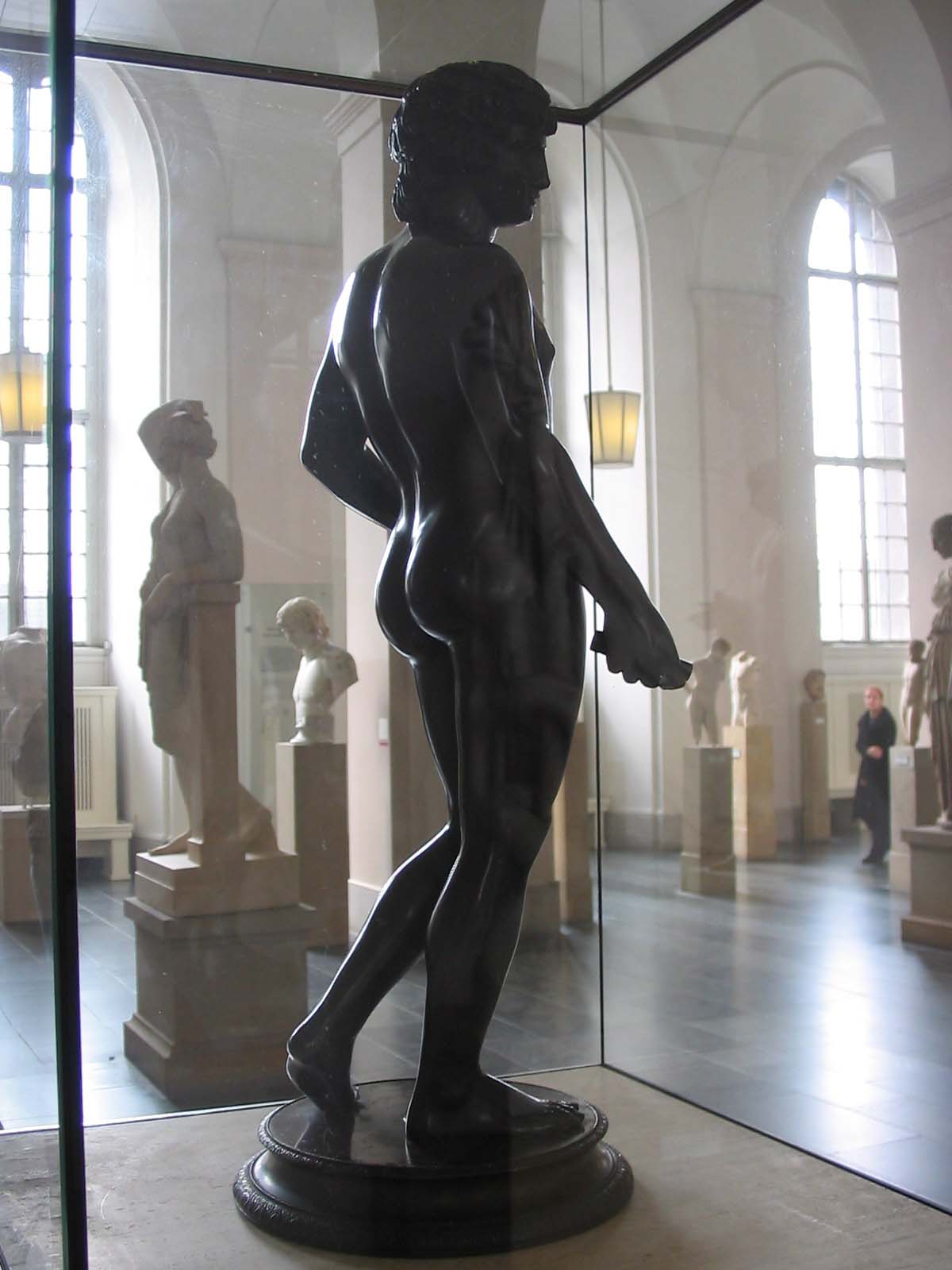
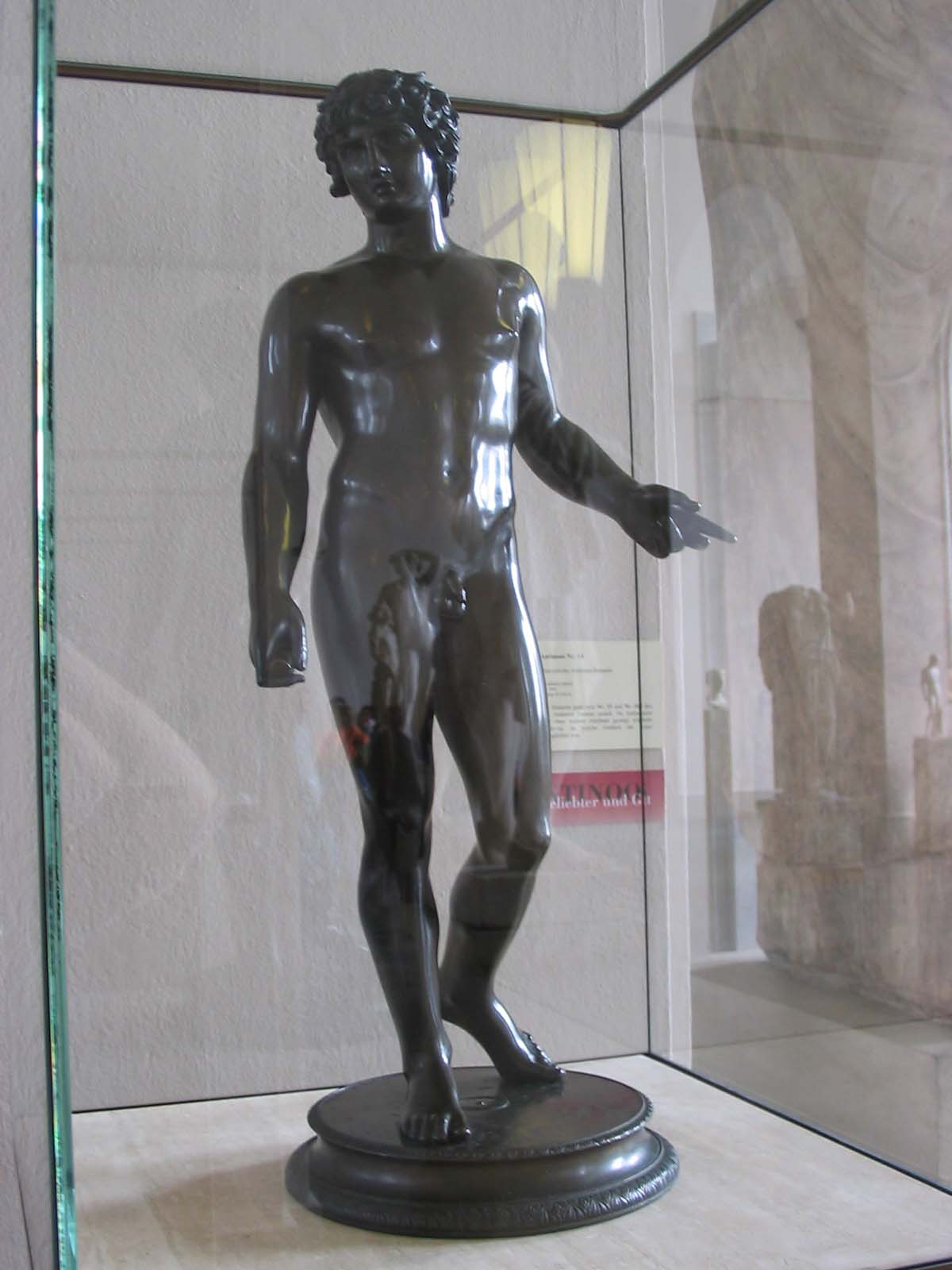
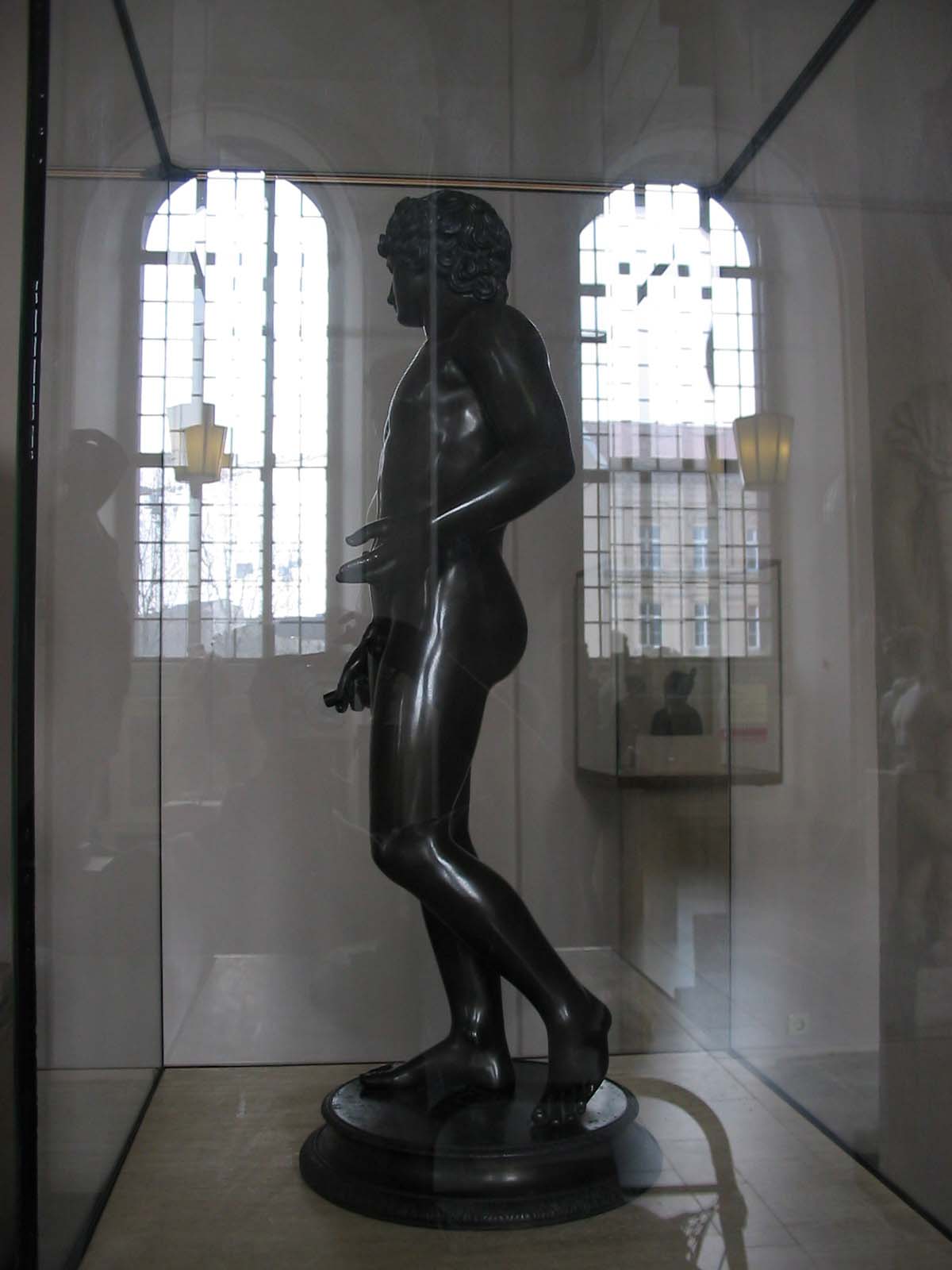
Bronze statuette dated end 1900, reproducing truthfully the Antinous Farnese.
Height : 66 cm. Private collection. Recently (2005) exhibited in the frame of
the exhibition Antinoos, Geliebter und Gott, held at the Pergamon Museum, Berlin.
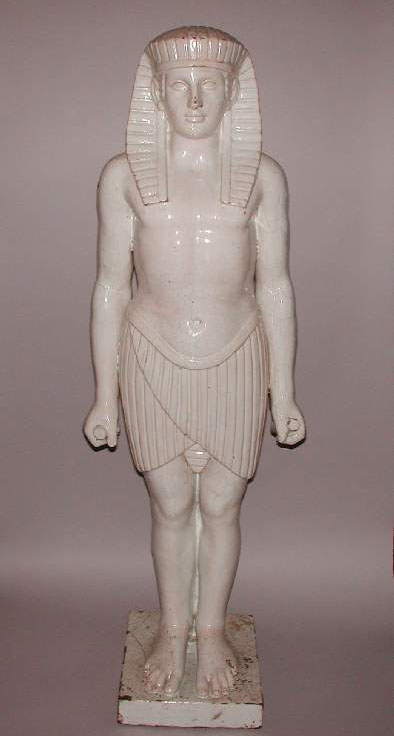
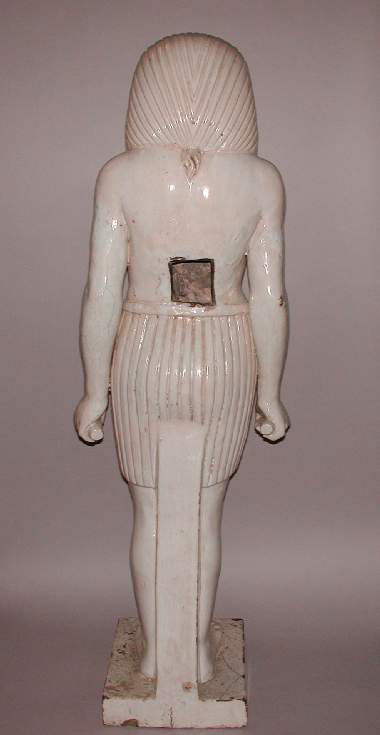
Cambridge, Fitzwilliam Museum. A pair of statues representing Osiris-Antinous,
probably Italian or French, ca. 1790-1820. Tin-glazed earthenware, 117.5 cm high.
Bequeathed by J.W.L. Glaisher in 1928. Accession Number C.2388A-1928 and C.2388B-1928.
Balsamaria
Berlin, Antikensammlung, Inv. 1988,4. Balsamarium Temporarily displayed in 2004
in the Altes Museum. Acquired in 1984 on the London art market. Original provenance
unknown. Bronze, 20.3 cm high. During the last years of the reign of Hadrian,
and probably for a certain time afterwards, a large number of such popular artefacts
were produced throughout the empire, to meet an obvious demand. Nowadays, about
20 balsamariums portraying Antinous have already been discovered and are now preserved
in Museums and collections all over Europe.
Belgrade City Museum, Balsamarium,
Inv. N° AA/2498, no further information.
’s Hertogenbosch (Netherlands),
Noord-Brabant Museum, exhibited in the room “Noord-Brabant” on the first
floor. Balsamarium found about 10 km south of ’s Hertogenbosch, during excavations
conducted in the winter 1959-60. «Les traits, évoquant ceux d’Antinoüs,
sont d’une grande pureté» (Marcel Edouard Mariën, 1980)
Denia (Spain), Museo archeológico.
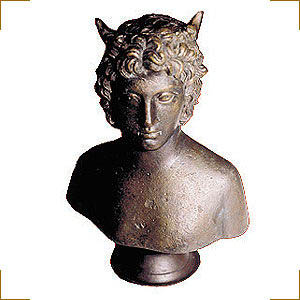
Balsamarium, considered to be a head of the god Mercury (because of the winglets),
but also undeniably comparable to the "Antinous type". The balsamarium
of Denia was created in Hadrian’s time. The slight inclination of the head
and the melancholic look relate it to Antinous. It was found in a Roman house
close to the port of Denia, the Roman Dianium.
Munich, Staatliche Antikensammlungen.
Inv. N° SL.30, exhibited in Room IX, showcase 12. Balsamarium, formerly in
the Loeb collection.
Varna (Bulgaria). Archaeological
Museum. Balsamarium representing unequivocally Antinous.
Roman balsamarium, found in Alexandria, inspired by the features of Antinous and
dated mid-2nd century AD. Bronze, 25.9cm high. Private collection. Source : www.barakatgallery.com
Roman balsamarium, found in Italy, inspired by the features of Antinous and dated
mid-2nd century AD. Bronze, 22.9 cm high. Private collection. Source : www.barakatgallery.com
Art market. Balsamarium in the form of a bust of Antinous. Origin: Greece, ca.
130-200 AD. Bronze, height : 19.7cm. On sale at Barakat-Gallery
Royal-Athena Galleries, Art of the Ancient World, vol. XIX (2008), p. 35, n°68.
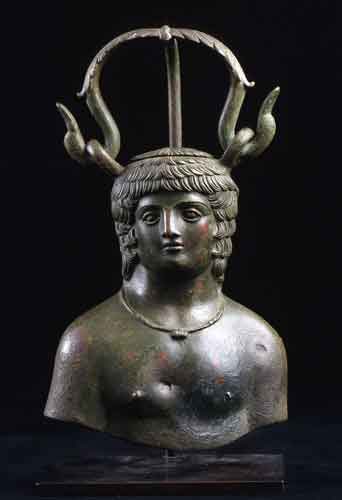
Balsamarium, 11,8 cm high. Balsamaria are numerous indeed and Antinous seems to
have been often represented. The hair is particularly refined and, particular
feature, the neck is scored to receive an inlaid necklace.
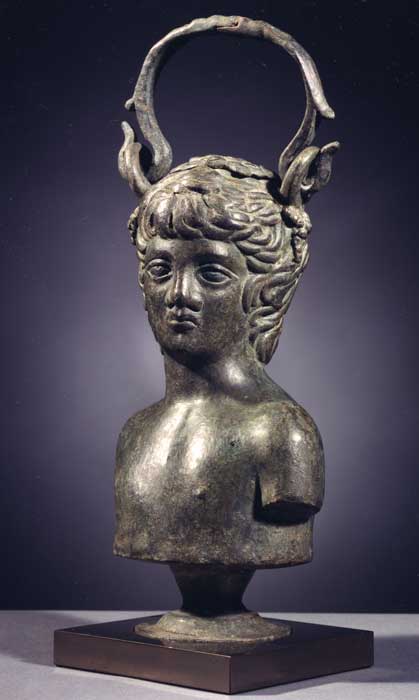
Royal-Athena Galleries, Art of the Ancient World, vol. XIX (2008), p. 34, n°66.
Head of Antinous, immediately recognizable. This balsamarium is noticeable by
its exceptional dimensions (12,1 cm high) and its remarkable state of conservation.
“ The legendary face is depicted surrounded with masses of tiered curls, the expression
modelled with alert eyes and incised pupils.” (Jerome M. Eisenberg, 2008)
Roman Balsamarium. If the features of the face do not immediately recall Antinous,
the abundant hair falling in generous locks deep on the neck points towards an
undeniable intention to represent him, and allows a more accurate dating. The
silver inlaid eyes and the drilled pupils add to the vivacity of the portrait.
Height 10,5 cm. Ex private collections, Germany, then Massachusetts. http://www.royalathena.com/pages/RomanCatalog/Bronze/Male/KM0901C.html Gems
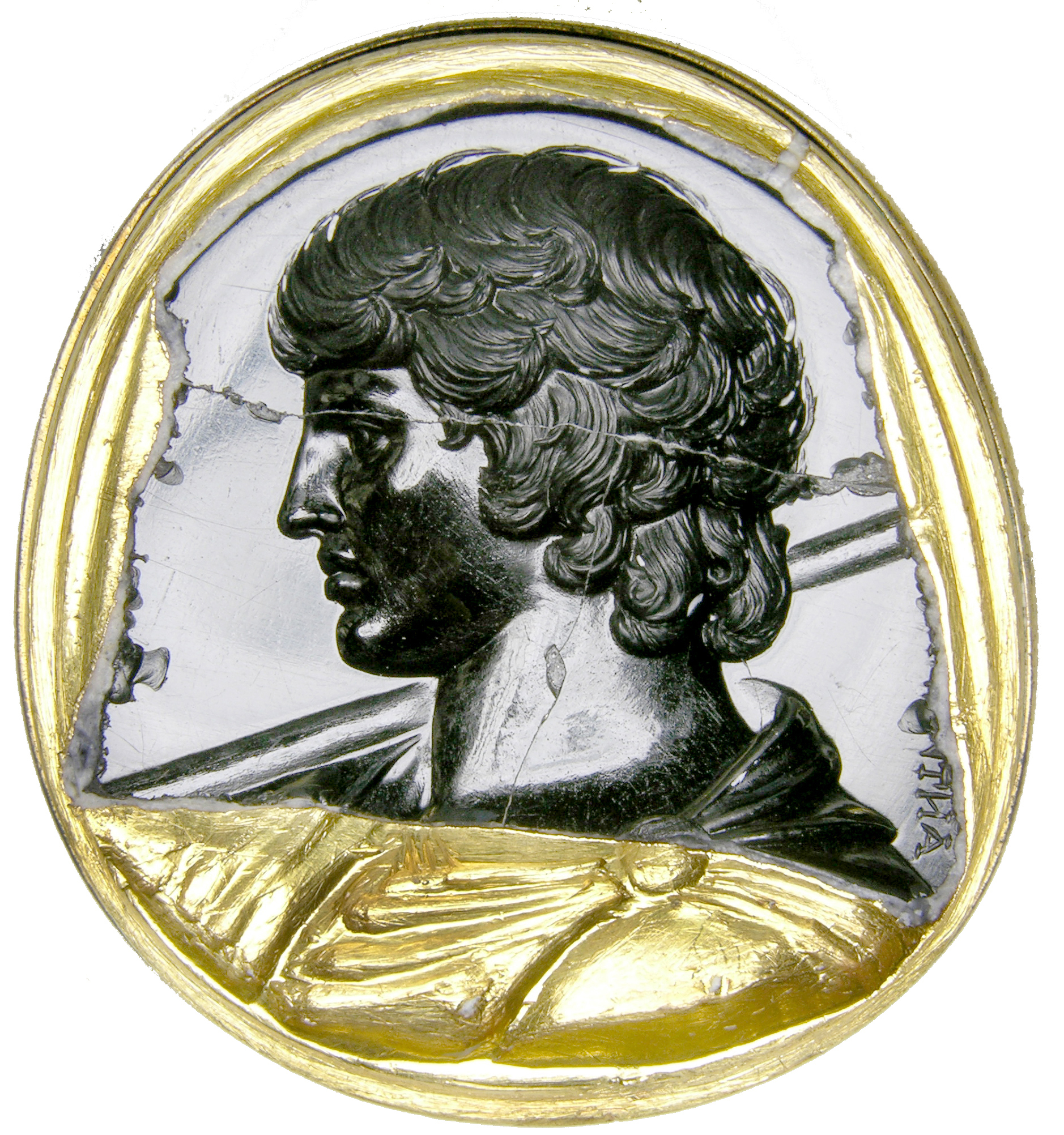
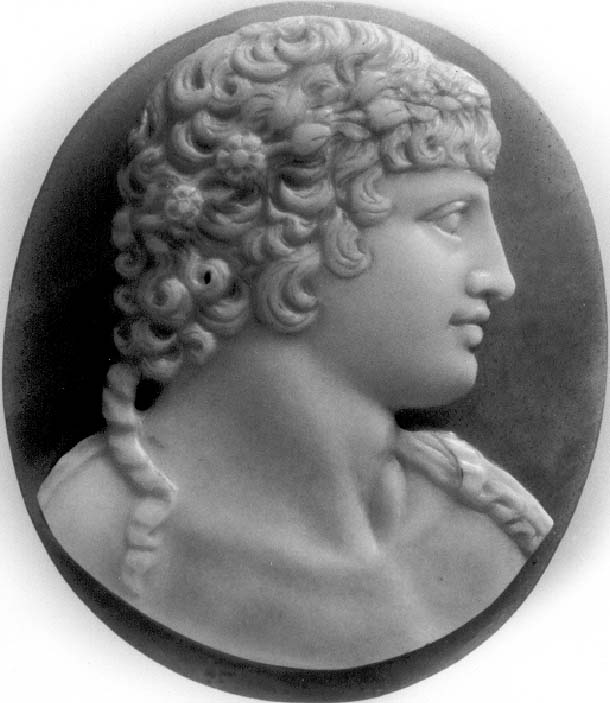
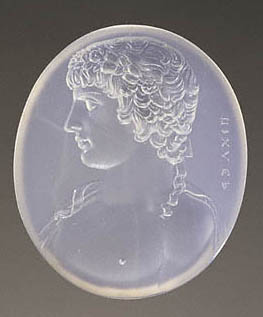
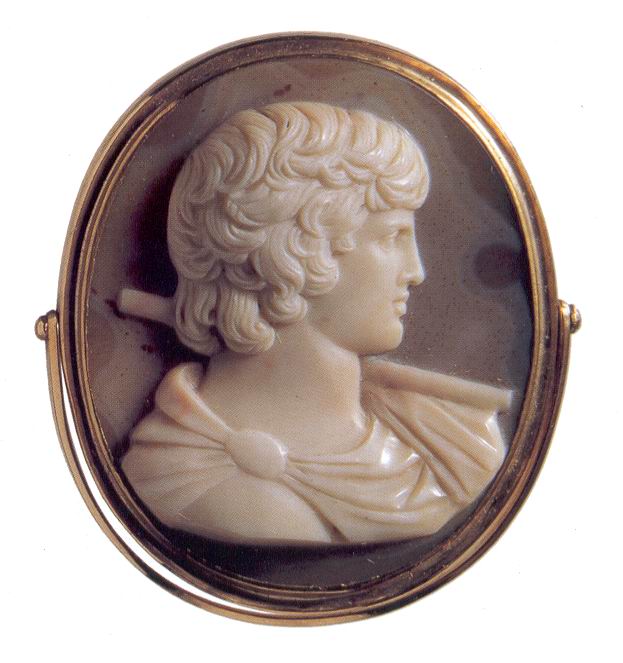
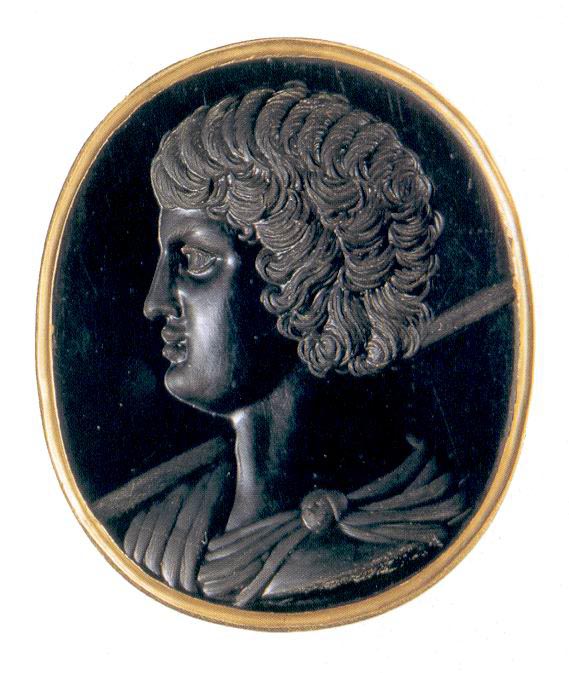
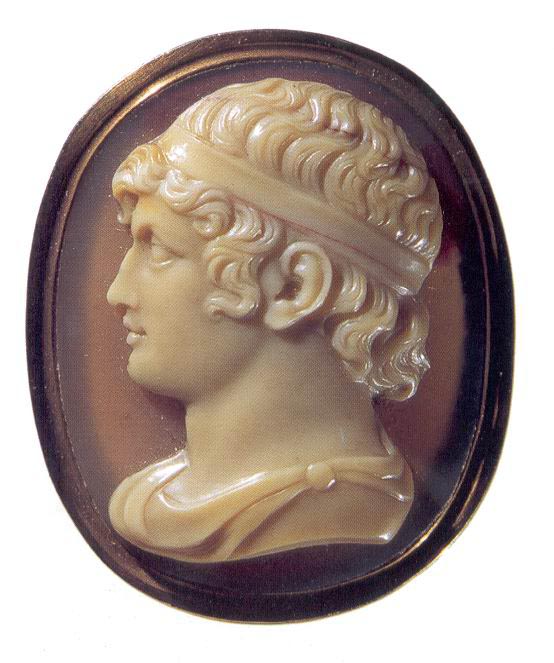
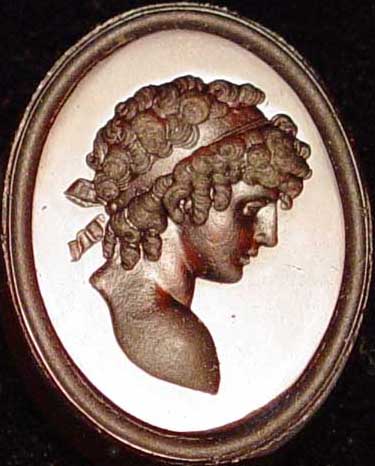
Private collection. Known
as the "Marlborough Gem", after a previous owner, the House of Marlborough, who
kept it from 1761 to 1875. The gem is mentioned for the first time in Venice in
1740, in the collection of A.M. Zanetti [1689-1767]. It can be traced as early
as 1720, but it is not known in which hands it was at that time, or where it was
found. «Le fameux amateur, et un peu marchand d’antiques à Venise, Antonio
Maria Zanetti – je ne sçais s’il vit encore – fit une fois vingt-trois ans l’amour
à un Antinoüs (une antique dont il fit l’acquisition), qu’il épousa enfin. Il
auroit, disoit-il, vendu sa maison pour l’acheter, s’il eût été parfait.»
(Pierre Clément, 1756). In 1761, it was bought from Zanetti by George Spencer,
4th Duke of Marlborough [1739-1817]. It was auctioned severaltimes since the end
of the 19th century: in 1875, 1899, 1909, 1952, finally 1999, which brought it
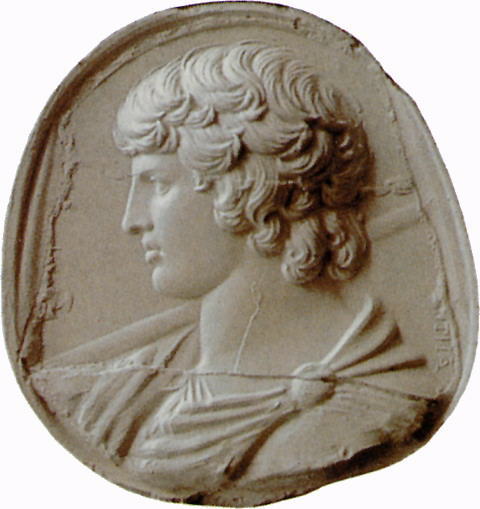
back to England. It is now in the possession of an anonymous collector. The first
photo shows the antique piece, which was restored and supplemented in gold before
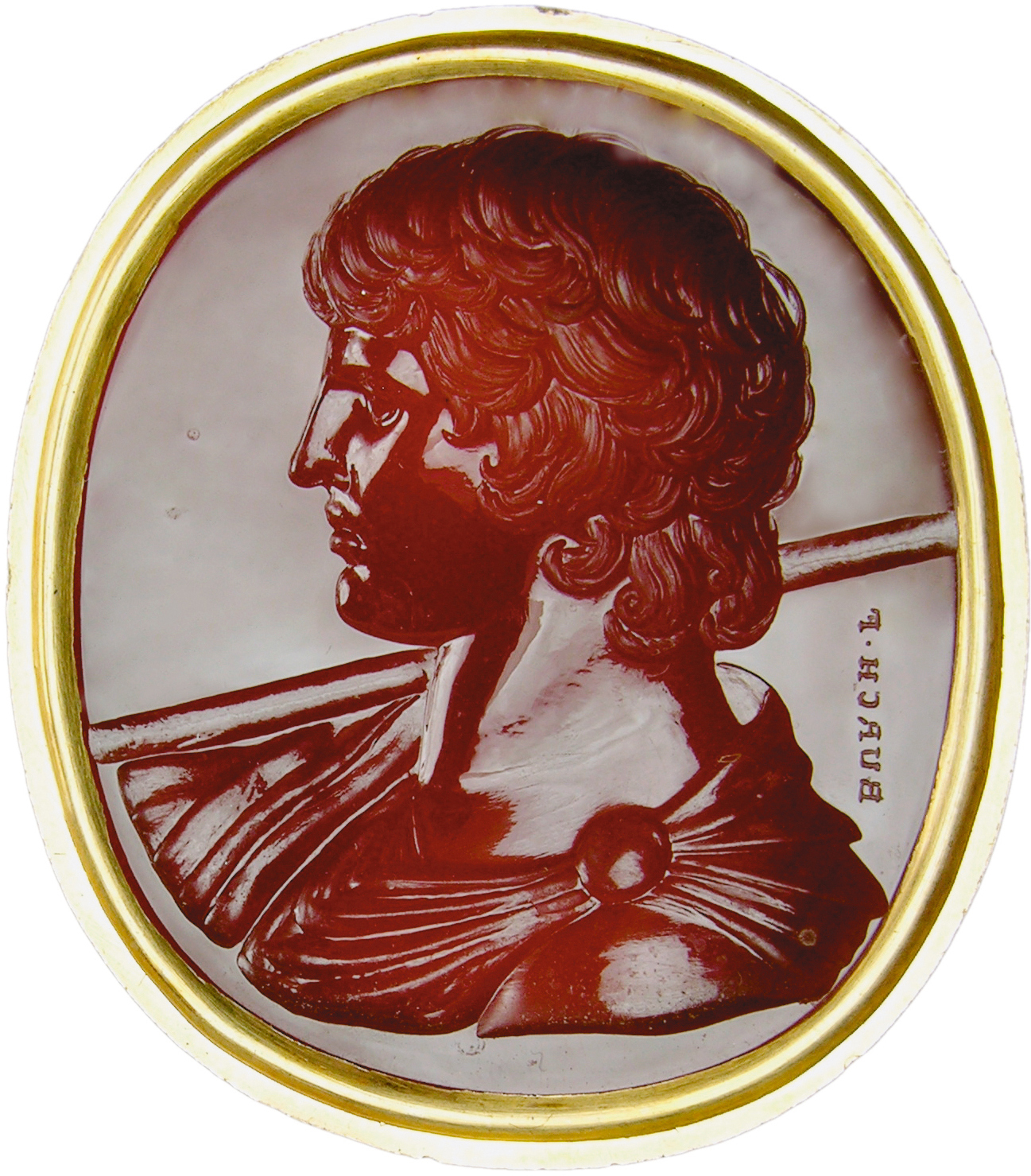
1740. The second photo shows a plaster cast of the intaglio. The third one is
an impression of it, made by Story-Maskelyne when he catalogued the Marlborough
collection. The gem has been copied frequently, most notably by the engraver Edward
Burch (signed Burch F[ecit]), commissioned by the Duke of Marlborough himself
and now also in a private collection (the fourth picture). Photos 1, 3 and 4 are
under copyright of Dr. Claudia Wagner of the Beazley Archive, Oxford (http://www.beazley.ox.ac.uk/gems/marlborough/),
who has kindly put them at our disposal to be published in our collection. «De
tous les objets encore présents aujourd'hui à la surface de la terre,
c'est le seul dont on puisse présumer avec quelque certitude qu'il a souvent
été tenu entre les mains d'Hadrien» (Marguerite Yourcenar,
1951).
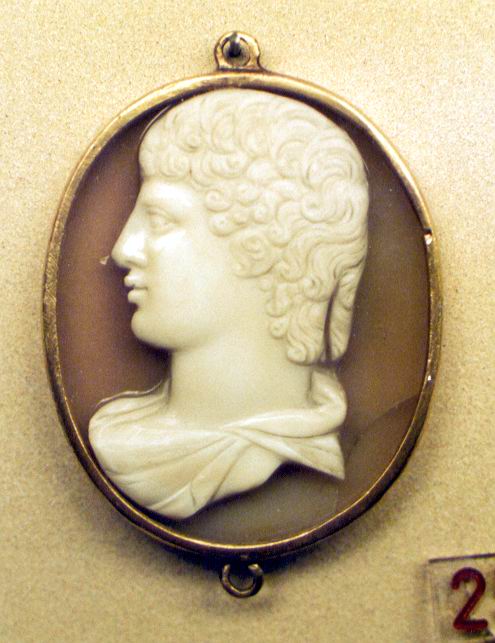
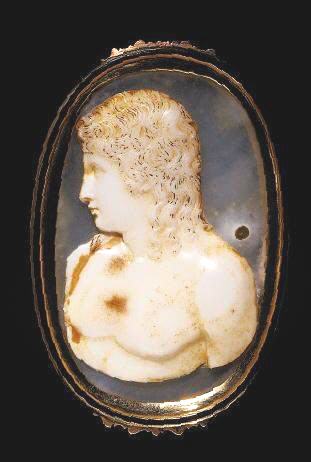
Florence, Museo Archeologico,
Room B, Case n°7, n°256. Antique cameo of Antinous, set in a golden frame
in modern times.
London, Sir John Soane’s
Museum, Inv. N° DS.213 (V.855). Antique cameo. Exhibited in the "Link
Passage".
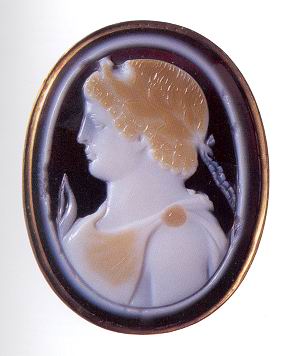
St Petersbourg, Eremitage,
Inv. N° J.323, 13 x 16 mm. Cameo intending to represent Antinous as Apollo.
The cameo is antique, the golden frame was added in the 18th century. Acquired
by the Eremitage at the end of the 18th century
Paris, Bibliothèque Nationale, Cabinet des médailles. Sardony cameo, antique.
Catalogue Babelon n° 238. Picture : Marie-Lan
Nguyen (Jastrow).
London, British Museum, Room
47, Showcase 4. Large cameo inspired by the Antinous Braschi (Vatican). Bequeathed
to the British Museum in 1978 by Professor John and Mrs Anne Hull Grundy. Engraved
Girometti in bold capitals for Giuseppe Girometti (1779-1851) or Pietro Girometti
(1811-1859).
JP Getty Foundation. 18th
century intaglio, signed "Pichler", probably Giovanni (1734-1791). Bust
of Antinous inspired by the most famous Albani relief, to satisfy the insatiable
demand from “Grand Tourists”.
St Petersbourg, Eremitage,
Inv. N° K.5093. Quite faithfull reproduction, as a cameo, of the celebrated
intaglio named "Marlborough gem". Carved in Italy by an unknown engraver
in the 2nd half of the 18th century. Acquired by the Eremitage at the end of the
18th century.
St Petersbourg, Eremitage,
Inv. N° I.9666. Intaglio carved in Italy in the 2nd half of the 18th century
by an unknown engraver. Acquired by the Eremitage at the end of the 18th century.
St Petersbourg, Eremitage,
Inv. N° K.3425. Cameo carved in Italy in the 2nd half of the 18th century
by an unknown engraver who rendered the features of Antinous rather freely, especially
the hair. Acquired by the Eremitage at the beginning of the 19th century.
Cameo representing the bust
of the Capitoline Antinous. His short hair and the inclination of the head point
unmistakably to this statue, most famous throughout the 18th and 19th centuries.
Source : Pommeraie Antiques
Homepage
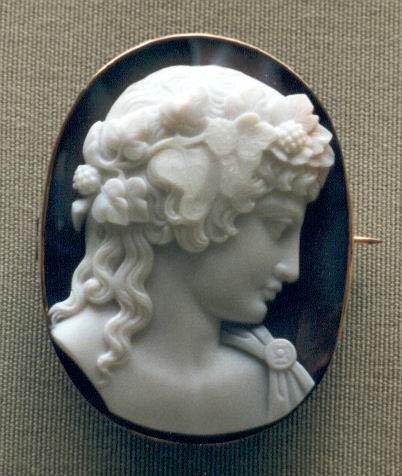
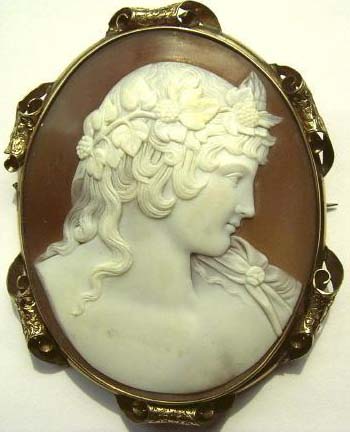
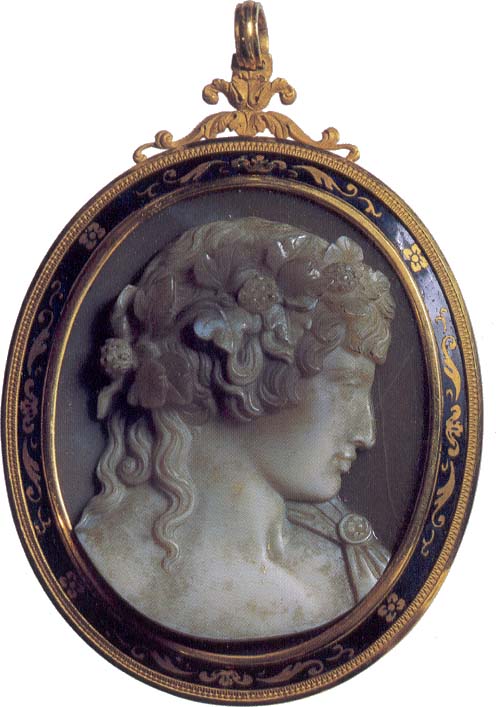
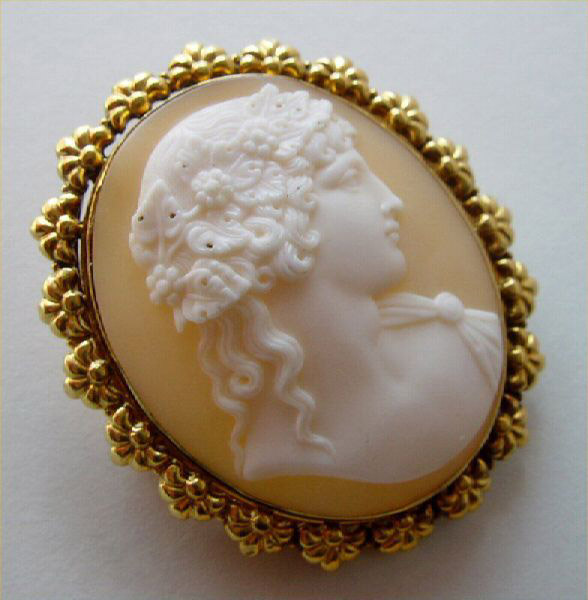
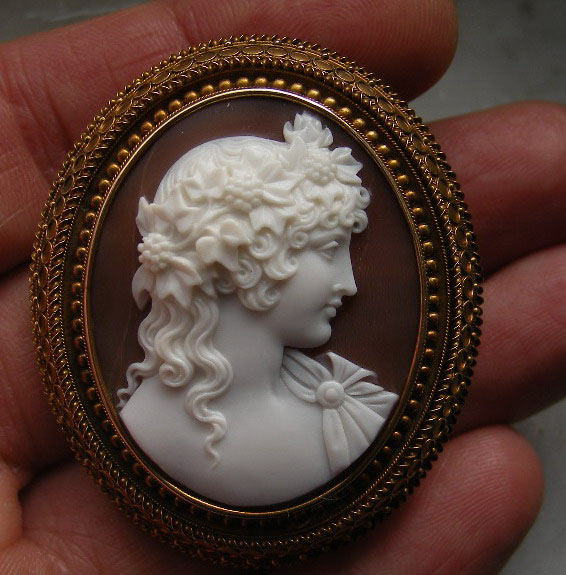
Cameo depicting the Antinous
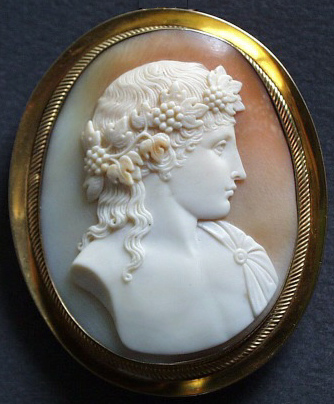
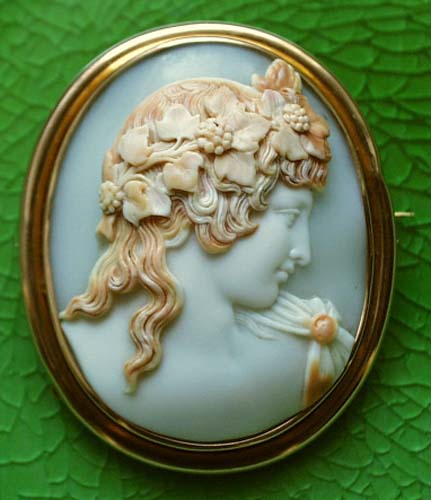
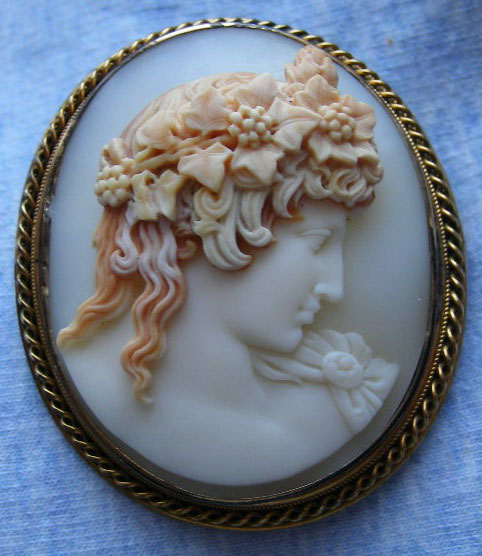
Braschi, of the Vatican. The Bacchic crown, the long hair falling on the chest
and on the back and the toga laid on the left shoulder are directly inspired by
the statue. The pine on top of the head of the statue, which is a modern addition,
is not represented on the cameo. Italy, ca. 1850. Source : Pommeraie
Antiques Homepage
Cameo showing the head of
the Antinous Braschi. High relief cameo, ca. 1840. Private collection. Pommeraie
Antiques Homepage
Cameo representing the Antinous
Braschi, signed by Barthali, ca. 1860. (70mm x 57 mm). Private collection. Source
: http://www.rubylane.com/ni/shops/rowan/iteml/2310
Large Cameo, showing the Antinous
Braschi, ca. 1850-1860. (100 mm x 70 mm). Private collection. Source : http://www.rowanandrowan.com/
Vatican, Library of the Museo
Profano. Cameo depicting the Antinous Braschi, signed Girometti. Acquired by Gregory
XVI in 1845. This cameo, large in scale and in high relief, could be due to Pietro
Girometti (1812-1859), son of Giuseppe Girometti (1779/80 – 1851).
Cameo dated ca. 1880, representing
the Antinous Braschi. Approximate size: 44 x 39 mm. Private collection.
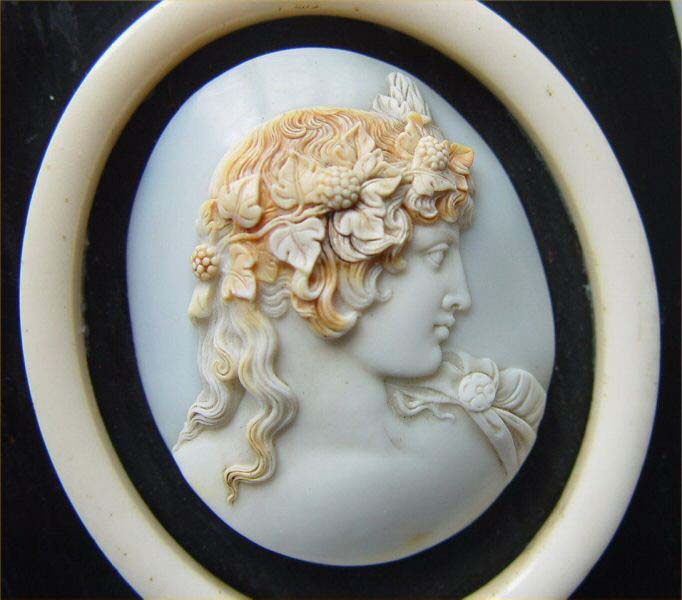
Large cameo, 66 x 55 mm, set in an ivory frame, dated ca. 1880 and depicting the
Antinous Braschi. Private collection.
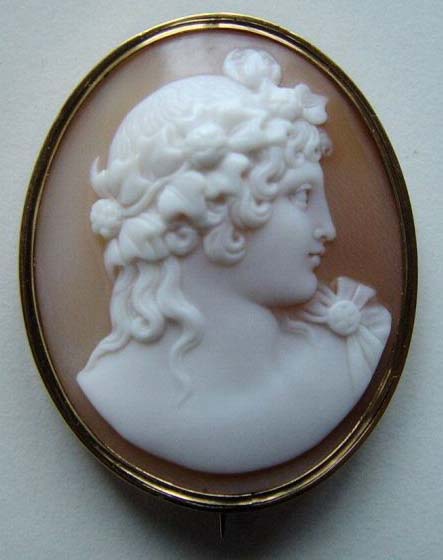
Private collection. Cameo
mounted in a 40 x 32 cm brooch, dated ca. 1880, inspired by the Antinous Braschi,
most popular subject for art collectors during the second half of the 19th century.
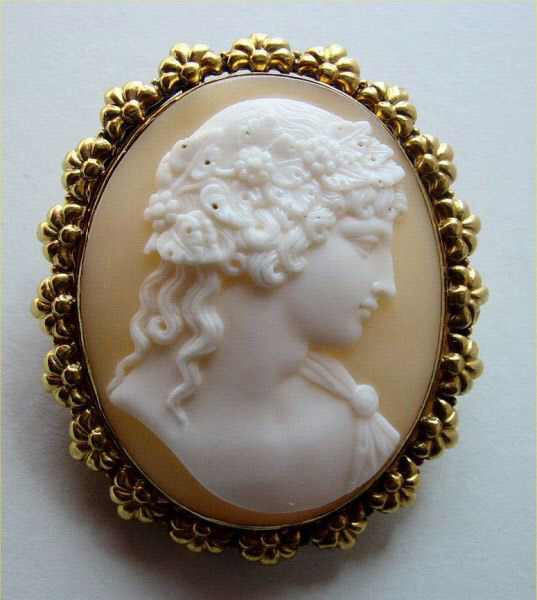
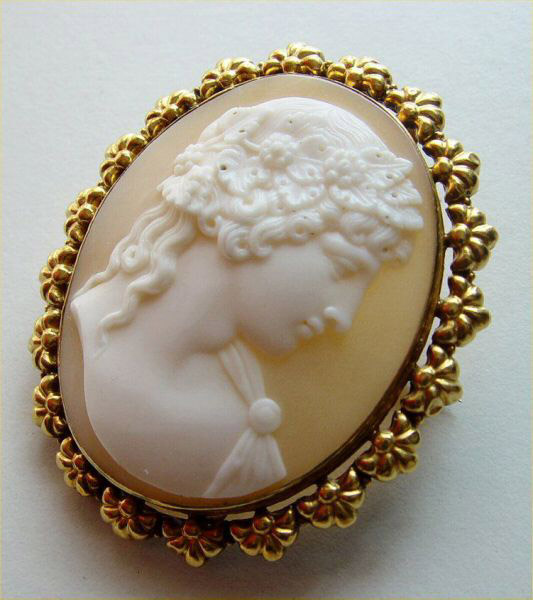
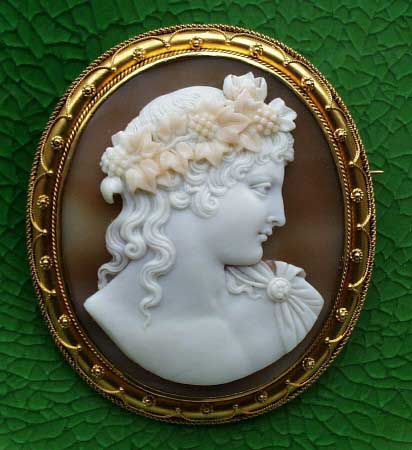
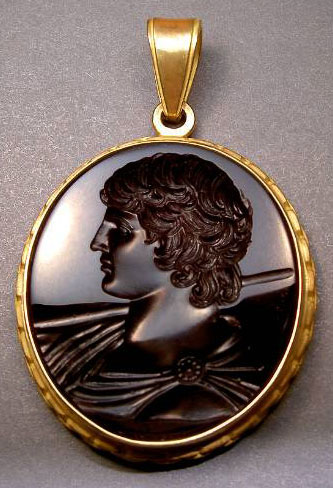
Large Italian cameo representing Antinous, set in an elaborate golden frame of
overall dimensions 56 mm x 46mm. Dated ca. mid-1840, it is one of the first cameos
to have been prompted by the Antinous Braschi. Private collection.
Cameo of Antinous Braschi,
a very popular subject in high demand since the mid-19th century. This cameo is
dated ca.1850-1860. Overall dimensions : 59 x 48 mm Private collection. Source:
Pommeraie Antiques Homepage
Cameo after the Antinous-Braschi. Dated ca. 1850-60. Overall size: 2 11/16 x 2
5/16 mm. Private collection. Pommeraie
Antiques Homepage
Private Collection. Antinous Braschi, ca. 1840, in a golden frame.
http://www.antiquecameos.net/antinoo.htm
Cameo, 8.2 x 5.6 cm, probably
18th century. Former collection Roger Peyrefitte (1907-2000), Paris.
Private collection. Sardonix cameo depicting Antinous Braschi, dated mid 19th
century, set in an exquisite gold frame. 1 7/8" by 1 5/8".
Private collection. Vitreous paste intaglio inserted in a gold setting, 25 x 35
mm. Free and accurate representation of Antinous. .
Private collection. Modern reproduction of the Marlborough Gem : reddish brown
glass intaglio set in yellow gold setting. 33 mm x 30 mm
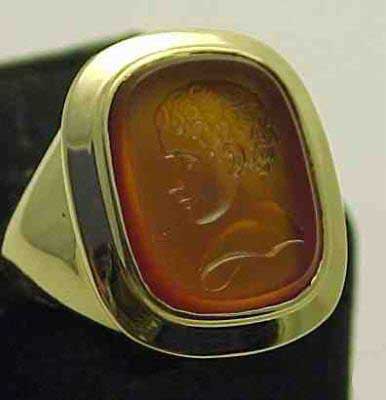
19th century intaglio, inspired by the Capitoline Antinous, subsequently set in
a ring. Private collection. Approximate dimensions : 18 x 14 mm.
Modern representation of Hadrian and Antinous. Lapis Lazuli intaglio. Private
Collection, USA. Source : Barakat-Gallery
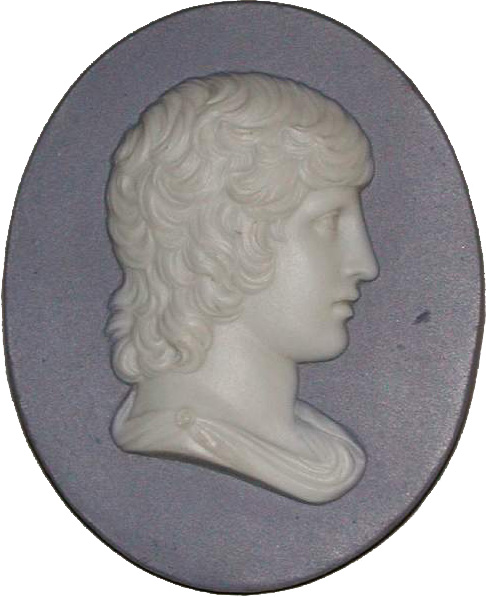
Cambridge, Fitzwilliam Museum. Medallion of Antinous, by Wedgwood & Bentley. Pale
bluish-grey jasper with white relief, 5.5 cm x 4.5 cm, ca. 1775-1780. The 1779
Catalogue of cameos, etc., by Wedgwood & Bentley, already listed this type of
cameo, inspired by the Marlborough gem. The particular cameo illustrated here
was bequeathed to the Fitzwilliam Museum in 1960, by Clarke, Louis Colville Gray.
Accession Number C.106-1961.
Amber glass intaglio, 25 x
19 cm, created in the 18th or 19th century. Inspired by Antinous to satisfy the
demand of Grand Tourists. Private collection. Source : www.edgarlowen.com/a54af.html